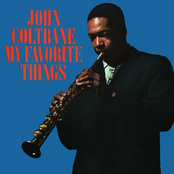
Tracklist 4 tracks
#
Title
Plays
1.
My Favorite Things
42
2.
Everytime We Say Goodbye
-
3.
Summertime
-
4.
But Not for Me
-
📖 About this album
YOUR PLAYS
41 scrobbles
TOTAL PLAYS
2000739 scrobbles
LISTENERS
237876
My Favorite Things is the seventh studio album by John Coltrane, released in March 1961 by Atlantic Records (1361). It marked the first time Coltrane prominently recorded on soprano saxophone, introducing a new element to his sound. An edited version of the title track was issued as a single and received significant radio airplay in 1961. The album achieved strong commercial success and became one of Coltrane’s best-known releases from his Atlantic period. Background In March 1960, during a European tour, Miles Davis bought John Coltrane a soprano saxophone. Although the instrument had been prominent in early jazz through players Read more on Last.fm.
Read more
My Favorite Things is the seventh studio album by John Coltrane, released in March 1961 by Atlantic Records (1361). It marked the first time Coltrane prominently recorded on soprano saxophone, introducing a new element to his sound. An edited version of the title track was issued as a single and received significant radio airplay in 1961. The album achieved strong commercial success and became one of Coltrane’s best-known releases from his Atlantic period.
Background
In March 1960, during a European tour, Miles Davis bought John Coltrane a soprano saxophone. Although the instrument had been prominent in early jazz through players like Sidney Bechet, it had largely fallen out of use by the 1950s, aside from musicians such as Steve Lacy. Coltrane began experimenting with the soprano later that summer in club performances.
After leaving Davis’s group, Coltrane formed the first working version of his quartet for engagements at New York’s Jazz Gallery in 1960. By the autumn, the lineup included McCoy Tyner on piano, Steve Davis on bass, and Elvin Jones on drums. Recording sessions at Atlantic Studios shortly before Halloween produced “Village Blues” for Coltrane Jazz and material later issued on several Atlantic albums.
According to Lewis Porter's biography, Coltrane described 'My Favorite Things' as 'my favorite piece of all those I have recorded'
Personnel:
John Coltrane – soprano saxophone on side one; tenor saxophone on side twoMcCoy Tyner – pianoSteve Davis – double bassElvin Jones – drums
"It's harvest time for John Coltrane. Fifteen years of serious and intelligent rotation have produced a bumper crop. Fifteen years of professional saxophoning have brought him from his debut in Philadelphia with a cocktail lounge combo, through bands led by Eddie Vinson, Johnny Hodges, Miles Davis and Thelonious Monk, to this record of his own quartet.
It started considerably before then, of course. Born in Hamlet, New York, September 23, 1926, John was surrounded by music as a child because his father played several instruments as a hobby. he began his own study on E-flat horn, then clarinet, finally switching to alto saxophone in high school. He had really wanted to play tenor ("Lester Young was my first real influence"), but his mother's friends advised her to get him an alto because it was supposed to be easier for a youngster to handle the smaller horn ("Johnny Hodges became my first main influence on alto, and his still kills me").
His musical studies continued at the Granoff Studios and at the Orstein School of Music, both in Philadelphia. And, the alto carried him into the cocktail lounge group in 1945, through one year with a Navy band in Hawaii and into the Eddie Vinson band in 1947 ("By that time I'd come under the influence of Charlie Parker").
Vinson hired Coltrane as a tenor player, and tenor player he became ("A wider area of listening opened up for me"). John discovered, as did so many, that no tenor saxophonist dominated the whole field as did Parker on alto. Instead, there were a dozen exceptional musicians from whom he could draw inspiration. He learned "simplicity" from Lester Young and, well, "something from them all . . . There were many things that people like Hawk, Ben and Tab Smith were doing in the '40's that I didn't understand but that I felt emotionally."
In 1948, just before joining Dizzy Gillespie, John played with the Jimmy Heath group in Philadelphia. While he readily admits that he was first excited into musical exploration by Parker and Gillespie, it was with Heath that the experimentation began to take shape ("Our musical appetites were the same"). Heath knew far more about musical construction than did Coltrane, and their friendship and practice together added considerably to John's development.
After working with Gillespie's big band and small group, Coltrane joined Earl Bostic ("a very gifted musician") in 1952. ("He showed me a lot of things on my horn"). A year later, Johnny Hodges hired him ("I really enjoyed that job . . . Nothing was superficial. It all had meaning, and it all swung"). In addition, John was filling-in his musical experience, learning first-hand about the past, a subject to which he is dedicated ("I'm back to Sidney Bechet already").
In 1955, he joined Miles Davis for two years, leaving to work with Thelonious Monk ("I learned from him in every way"). Monk answered dozens of his musical questions ("He showed me the answers just by playing them . . . Monk was one of the first to show me how to make two or three notes at one time on tenor"). And that was the beginning of part of the dazzling approach, what Ira Gitler has called the "sheets of sound," what other critics have damned as "just scales," which became standard Coltrane by 1958 when he rejoined Miles Davis.
Miles' own style was developing, becoming increasingly more selective and intense ("Miles' music gave me plenty of freedom"). Looking back at that period, John recalls that he was "trying for a sweeping sound." That, with the long, rapid lines, made for those "sheets of sound." In addition, he was beginning to use the three-on-one chord approach. "At that time the tendency was to play the entire scale of each chord. Therefore, they were usually played fast and sometimes sounded like glisses."
The spontaneous development, compounded of his varied musical experiences and searching mind, had crystallized to the point where it could be criticized. It was criticized and harshly, partly because, as John points out, "It just didn't always come off the way I wanted it to," but, mainly because he was dealing with the unexpected, no matter how disciplined and schooled his search may have been.
That is a major element in Coltrane — the unexpected. It is what makes following him not always an easy experience for the casual listener, but a rich experience for those who will match him with a seriousness of their own.
Unexpected is the word for his self-assessment and for his continuing development ("I've got to keep experimenting. I feel that I'm just beginning. I have part of what I'm looking for in my grasp, but not all"). Unexpected, too, the addition of soprano saxophone last February to the list of instruments he plays ("It lets me take another look at improvisation. It's like having another hand").
Not unexpected, though, is the quality of this album, which John has been moving towards during these fifteen years, and I have been getting to in these notes, which have deliberately set out to show that, while the whole is always dependent on the sum of its parts, some things are more equal than others, and John Coltrane has become a Gestalt reality, much more than even his considerable parts might indicate.
With the forming of his own group in 1960, which you hear here (excepting the substitution of drummer Elvin Jones), John became more flexible. If variety had been lacking, he determined to become more varied. He chose his material carefully to ensure that. And he chose his companions as carefully. Pianist McCoy Tyner is a highly intuitive musician in accompaniment, a soloist with rare ability to reach into the heart of a melody. Bassist Steve Davis, a most underrated musician, is the soul of strength and taste. Drummer Elvin Jones is richly inventive and rhythmically powerful. Together, they take the Coltrane track—direct, uncluttered, sometimes a-rhythmic, always rolling in pulsation, never sentimental. And varied: contrast the title tune, and John's almost middle-Eastern soprano flavor in strict waltz time, with Cole Porter's Everytime We Say Goodbye, John obviously as much concerned with the lyric as he is with the melody; or contrast those with either of the bright tempo tracks on the other side of this record. Add to those, Tyner's solos on the first two tunes, Davis' special strength on the second, and his solo on Summertime, and Elvin Jones throughout. The harvest, you see, is a many-splendored thing. And you will find it glowing within My Favorite Things.
Bill Coss"
Original liner notes Read more on Last.fm. User-contributed text is available under the Creative Commons By-SA License; additional terms may apply.
jazz
saxophone
john coltrane
free jazz
bebop
📝 About
-
🔗 Explore This Album
Rate Your Music
AllMusic
Last.fm
Discogs
MusicBrainz
Wikipedia
Google Reviews
YouTube
Bandcamp
SoundCloud
DeepSeek Chat
Links open in a new tab. Searches use the artist and album name from the current track. DeepSeek Chat opens the main chat – you can paste the album name there.